


After 15 years of planning and development, a major conservation project near the town of Florence has achieved its goal: connecting a large swath of restored farmland to the Oregon Coast. The Siuslaw Estuary is a 217-acre expanse that’s expected to accommodate the return of salmon, lamprey, shorebirds and native plants as it transforms with the tides.
A surge of water
May 29 was a cool, misty morning at the estuary. Excavators and dump trucks hustled around an earthen levee that held the Siuslaw River back from a former dairy site that used to be called the Waite Ranch. For more than a century, the area had been used for dairy operations and cow herds, with agricultural features such as perimeter dikes, a tide gate, and drainage ditches.
The McKenzie River Trust purchased the property in 2010 for $750,000 with a grant from the Oregon Watershed Enhancement Board. Redevelopment commenced in the late summer of 2023.
In the minutes leading up to the removal of an earthen levee, crews readied themselves and the property. Wearing a hardhat and reflective vest, Dan Kirk walked through the dewy brush and reddish mud, waving a smoking bundle of sage.
“I've been blessing the site almost daily,” said Kirk. “We really care about this project, and just putting as much intention and good thoughts and good feelings and gratitude as much as we can.”
Kirk is the restoration projects manager for the Confederated Tribes of Coos, Lower Umpqua, and Siuslaw Indians. Other tribal members as well as partner organizations for the estuary project were gathered nearby to witness the historic event.
“Today we will be reconnecting the tidal Siuslaw River into the site,” explained Kirk, “creating about 180 acres of new wetland that was historically tidal wetland before the mid-1800s when it became a dairy farm.”
Margaret Treadwell, the central coast conservation manager for the McKenzie River Trust, stood by as a towering excavator crawled towards the levee.
“This is really exciting,” she said. “I have never seen a levee breach before.”
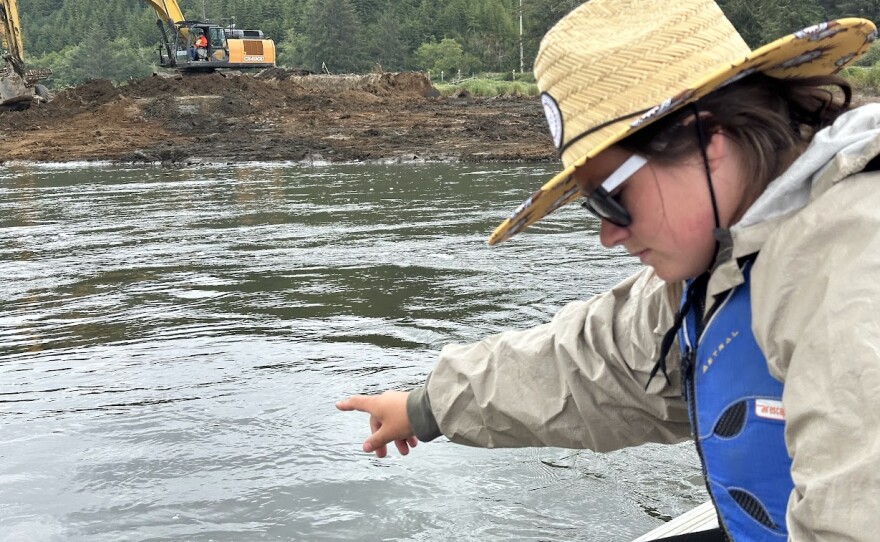
As the crowd watched, the excavator extended its toothy bucket and tore down a chunk of the levee. River water surged in immediately, as people cheered.
“Keep an eye out for animals coming back in,” said Treadwell. “Apparently when these breaches happen, the animals figure it out very quickly.”
Treadwell said fish, birds, and even a seal could appear in good time.
The estuary began to fill with water it hadn’t contacted with for a century and a half. Many observers watched as the Siuslaw River water churned and poured into the estuary.
Chief Doug Barrett of the Confederated Tribes of the Coos, Lower Umpqua, and Siuslaw Indians looked over the reformed farmland which includes a 1.2 mile long berm that’s 12-feet high and was designed to protect Highway 126. The tribe sees this site as a place to gather and practice traditions, as the salinity of the estuary will develop new plant and animal life.
With the cost of the project coming to roughly $15 million and the development taking nearly three years to complete, Barrett was happy to have witnessed the historic breach.
“I kinda got goosebumps. Been a long time comin’,” he told KLCC.
Barrett also shared its new name.
“Now it’s called haich ikt’at’uu. Haich ikt’at’uu is the “heart of the river,” and so this is a pretty awesome place now to call our home,” he explained. “Just awesome to see the water coming in, knowing that the salmon and lamprey could come in here and hide from all of our predators. It’s a pretty good feeling.”
A waterborne blessing
Roughly four hours later, a contingent of tribal council members arrived in “Lottie,” a 32 ½-foot-long dugout canoe carved from Western Red Cedar. They paddled in from the Port of Siuslaw, nearly four miles away. After crossing through the mouth of the newly-opened channel, the group sprinkled tobacco and tule seeds into the water.
Jesse Beers, the cultural stewardship manager for the Confederated Tribes of Coos, Lower Umpqua, and Siuslaw Indians, lowered the remains of a salmon into the brackish currents.
“When we were in the channel there, almost brought tears to my eyes,” he said. “Returned some salmon remains to let the salmon people know it’s a good place to come again. And fatten up and be healthy. It’s just an amazing experience.”
Besides the tribes and McKenzie River Trust, the Siuslaw Watershed Council is another partner. Its restoration project manager, Mizu Burruss, said partnerships like these are essential due to the financial and logistical challenges a lone organization would face.
“And they’re not only essential to making them happen, but they make them richer, better, more complex, and diverse projects,” said Burruss. “Which, when we're talking about ecosystem restoration, that's what we want.”
By midday, the Siuslaw Estuary was submerged with increasingly salty water, as cormorants and swallows swooped overhead. Chief Doug Barrett looked out at the expanse and nodded.
“It’s great to see the water coming in,” he said. “It’ll come in all day, from now on, hopefully, ‘til the end of time.”
Copyright 2026, KLCC.


