


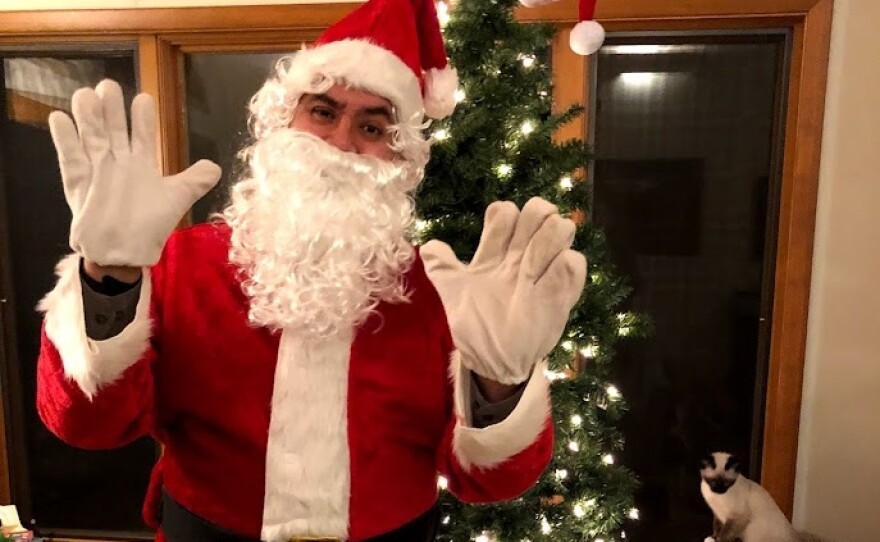
When you think of what Santa Claus looks like, what’s the first image that comes to mind? Chances are you’ll think of a portly, elderly figure in a bright red suit, black boots, and…a white man. That’s mostly from the 1930s depiction popularized by Coca-Cola. But an ongoing initiative in Oregon is sharing non-traditional Santas, who give kids and their families a holiday figure they can relate to.
It was a foggy night in North Eugene earlier this month, but it became clear upon entering the Maxwell Community Hub that the Cozy Sweater Party organized by Transponder was both lit and welcoming of the LGBTQ+ crowd.
Darrius Yannick, a transgender man, wore a brightly colored sweater with a llama on the front.
“There are lots of other queer and trans people, I really appreciate it,” said Yannick. “Being able to be seen for who I am and not just passed by is really nice. I feel like it’s a really inclusive environment.”
Beyond the vendor tables and raffle baskets sat Drag Santa and Mrs. Claus, flanked by rainbow-striped Christmas trees. Portrayed by local drag performers Heavy Cream and Shirley Mental, the two were aglow in regal red finery. The pair told KLCC that with all the political turmoil surrounding LGBTQ+ people this year, it was nice to have a haven.
“We need space to be happy,” said Heavy Cream. “We need space to get a break from things and get to share in the love of each other.”
“Especially for queer people during the holidays, sometimes it’s really hard,” added Shirley Mental. “Not a lot of us have strong family ties any longer, and it’s great to get together with chosen family. It’s really beautiful and very healing.”
Marlie Yasuhara, Transponder’s development and outreach coordinator, acknowledged that it’s been a rough year for the transgender community especially. The “Cozy Sweater” event is to provide LGBTQ+ people and their allies a fun and safe place to get together.
“The idea is sort of a festive family gathering,” said Yashura. “It plans for a change for people to see one another and be reminded that they’re not alone, especially as winter happens.”
Meanwhile, over at the Chifin Native Youth Center in Springfield, a Santa sporting a feather bustle, ribbon shirt, and a candy cane eagle staff entered a packed classroom. This is “Solte Santa” - an Indigenous take on old St. Nick, played by Jerry Payne, a Native man of Salish heritage.

“’Solte’ in Salish means “warrior” so I wanted to honor that,” explained Payne. “And I’m a veteran myself. Every community has their own style of Santa so I wanted to make sure that the Indigenous Natives got to be represented as well.”
Solte Santa and his troupe (which includes Mrs. Claus, Peppermint the Elf, and others from the North Pole) have made nine appearances across Portland, Eugene and other places this month, listening to kids’ wish lists and posing for family photos.
And while he contrasts with the iconic Coca-Cola Santa from the 1930s, Payne said that’s a plus.
“The mall Santa or typical Santa that everybody knows like the Coca-Cola Santa? For whatever reason, kids are scared of that Santa,” said Payne. “But I’ve had kids that – their parent would say that they would never come up to take a picture with me. Next thing you know, they’re hugging me and jumping in my lap and we take a good picture. Their parents are crying because they never got a good picture with their kid.”
The Indigenous/Native Santas began more than 25 years ago, with the Northwest Indian Veterans Association. Past Santas have featured members of the Wasco, Crow and Lakota nations. Each Santa’s regalia is a fusion of traditional Native elements such as beadwork and feathers, and the typical Santa attire.
These coordinated appearances come via a Eugene-based initiative called the BeLonging Space, which focuses on inclusion. It’s building on success with a Black Santa event in Portland held in 2022. Executive director Naphtali Renshaw said they’re hoping to get Santas recruited for the Latinx and Asian communities soon.
“Oregon’s very white in general, but Eugene’s very white,” said Renshaw. “And so for families who live in diverse experiences, they probably haven’t had the opportunity to have a Santa that looks like them. And that’s really, really important.”
A study involving an Oregon State University scholar looked at non-traditional Santas. Bori Csillag, OSU’s Stirek Assistant Professor of Management, said for many Father Christmases, spreading love and joy for the holidays surpassed the need to conform 100% to the mainstream depiction of Santa.

“The Coca-Cola Santa, that prototype does seem to still dominate in some ways,” Csillag told KLCC. “But it’s not actually the origination of the myth of St. Nicholas and Father Christmas. So it makes perfect sense that we found that Santa Claus is portrayed by a more diverse group of people than we might imagine.”
At a Black Santa Event in Eugene this past weekend, dozens of families lined up outside the People’s Collective to get their pictures taken with the jolly old elf. Organizer and executive director Talicia Brown said Santa’s roots go all the way back to the fourth century, in the Middle East region now known as Turkey. And while some may debate Santa’s skin color, Brown said that’s not central to what he represents.
“What we know to be true is that Santa represents joy, represents love, represents the spirit of gift-giving and giving from the heart,” said Brown.
Dressed up in red suit, beard and spectacles, former KLCC music host Greg Black prepared to play Black Santa. Besides listening to kids’ wish lists and posing for photos, he also read children’s stories which is his favorite part of the program. Black said as a kid, there were never any Santas reflecting his community growing up.
“As they would say in some of the large cities like Chicago, ‘Now we know ain’t no white man gonna come up in this neighborhood and talk about bringing some toys,’” chuckled Black. “So folks of color need to have some representation of their own.”
All the Santas interviewed for this story engaged kids with stories, hugs, and candy canes, tirelessly and with pure jolliness. Even if they don’t mirror the mainstream image, OSU researcher Bori Csillag said that’s not crucial.
“They see the fit, they hear the calling in their heart, they know that they are able to portray this role successfully.”
Transponder’s Yasuhara does see some pushback from more traditional-minded folks who conform to more nostalgic depictions.
“But I think as a culture we need to embrace change, and we need to embrace having marginalized communities to see themselves as well, and having us seeing other communities because that’s how empathy is built.”
Copyright 2025, KLCC.


