


Last September, a humpback whale off the coast of California and another off the coast of Mexico were found dragging gear from Dungeness crabbing operations in Oregon. In November, rigging from the Oregon Dungeness crab fishery caused the stranding of a juvenile humpback whale on the beach in Yachats that was subsequently euthanized, according to wildlife officials.
Whale entanglements are becoming more common along the west coast of the United States, with NOAA Fisheries reporting as many as three dozen confirmed sightings in 2024.
In an effort to prevent the entanglements, last year, the state of Oregon mandated that commercial crabbing operations reduce the number of pots they deploy and stick to shallower waters on May 1. Now, state regulators have moved the date earlier in the season, April 1.
The impact of the change
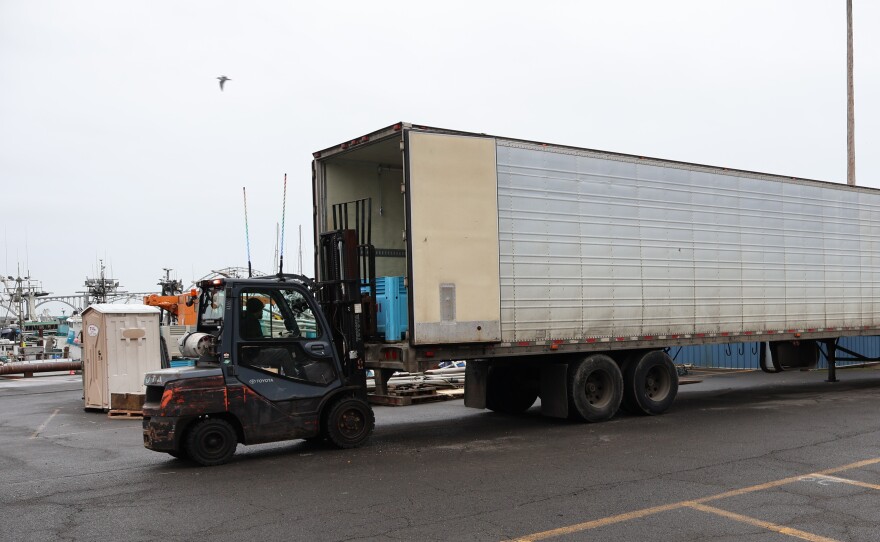
Poggy Lapham is owner/operator of the 66-foot, Newport-based fishing vessel Michele Ann. On a recent morning, Lapham stood on the bridge of his boat while watching a small crane lift five-foot-square plastic bins brimming with freshly-caught Dungeness crab from the ship’s hold. A forklift took the bins to a scale and then a refrigerated tractor-trailer.

Lapham said the crabbing community was not consulted about the new rules, and even though the change will likely not impact his bottom line, it will undermine the profitability of many smaller operations.
“I typically don't fish [for crab] that late in the season, as it is, but if you look out the window of this boat right now, I can pick out a whole bunch of boats where that is an essential part of their season,” he said.
Typically on April 1, Lapham begins to harvest sablefish, which is also known as black cod. He uses traps that sit on the sea floor like crab pots. And just like crab pots, the denial-of-exit trap is tethered to a rope and a buoy that floats on the surface.
Lapham knows the industry well. In fact, he’s a member of the federally mandated West Coast Take Reduction Team for sablefish pot fishing.
Working to reduce entanglements
A Take Reduction Team brings together disparate stakeholders to include fishers, regulators, conservationists, tribes, policy makers, and scientists to build consensus and best determine sustainable policy. The goal is to reduce accidental death and injury to marine mammals during commercial fishing operations, as mandated by the 1972 Marine Mammals Protection Act.
That there is a sablefish Take Reduction Team working to reduce whale entanglements is not the result of political will or that federal law mandates it: It’s the result of a successful lawsuit filed by the Center for Biological Diversity.
And, according to a spokesperson for NOAA Fisheries, once the current Take Reduction Team satisfies the court order regarding sablefish pots, the agency may or may not turn to other West Coast fisheries, such as Dungeness crab. There is no current plan or stated intention to do so. In that context, the Center for Biological Diversity and partners have shifted their focus to the state of Oregon.
Last December, the Center for Biological Diversity along with Oceana, Natural Resources Defense Council, and the American Cetacean Society submitted a petition to the Oregon Fish and Wildlife Commission that recommends a suite of sweeping new deployment and equipment rules for Oregon’s Dungeness crab fishing fleet.
Ben Grundy is an Oceans Campaigner for the Center for Biological Diversity and said the state’s temporary rules are a step in the right direction.
“The intention of the petition is to try and start a collaborative process to implement stronger regulations,” said Grundy “We know that rulemaking and council meetings and commission meetings are opportunities for various stakeholders, from fishing communities, from the NGO community, from the state to all get together and try and work together to solve a problem.”

Part of the proposed solution is the adoption of a system of “ropeless” or “pop up” traps. The petition urges the state to reduce the amount of fishing gear in the water during whale feeding and migration seasons and open a pathway for fishers to use pop-up fishing gear, which eliminates untended buoy lines.
Pop-up gear has been tested in the California Dungeness crab fishery with positive results. But Lapham has questions about cost and effectiveness that can only be answered through a season of widely-distributed use.
“We've been told there's a deadline when we have to use this gear by, even though we're not yet allowed to try it out. And so it's kind of getting the cart in front of the horse,” Lapham said. “There have been some pilot programs in the state of California, and the gear itself, the ‘pop up’ gear, ‘remotely retrievable’ gear, was effective and successful. It was a really small sample size, just a handful of boats.”
And that introduces the issue of fairness, he said.
“The state isn't willing to allow the entire fleet to try it at once. They want to hand pick a few boats to do that,” Lapham said. “We're really trying to find a happy medium where the whole fleet can try this out, participate in its development, make sure it's effective.”
The Oregon Fish and Wildlife Commission is expected to respond to the petition at its Feb. 20 meeting. Despite these overtures of inclusiveness, Lapham is worried his industry is being left out of the process.
Some 70 Dungeness crabbing boat operators from Washington, Oregon and California met in Newport in January to attempt to form an industry trade group and thereby better communicate with the state regarding the proposed regulation and equipment changes found in the petition. Lapham said consensus is hard to find among politically diverse crabbers, but they are uniformly frustrated that their voices seem unheard. Lapham described concern over the possible new rules as “overwhelming.”


