


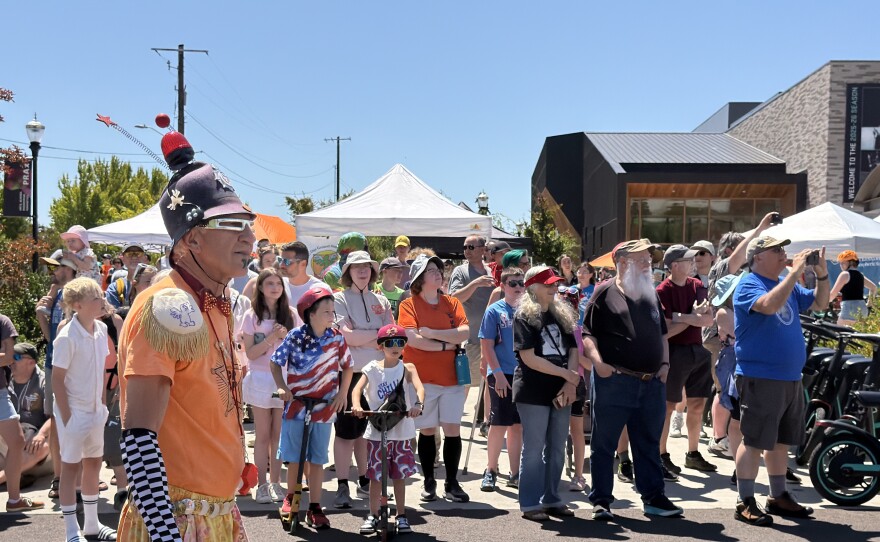
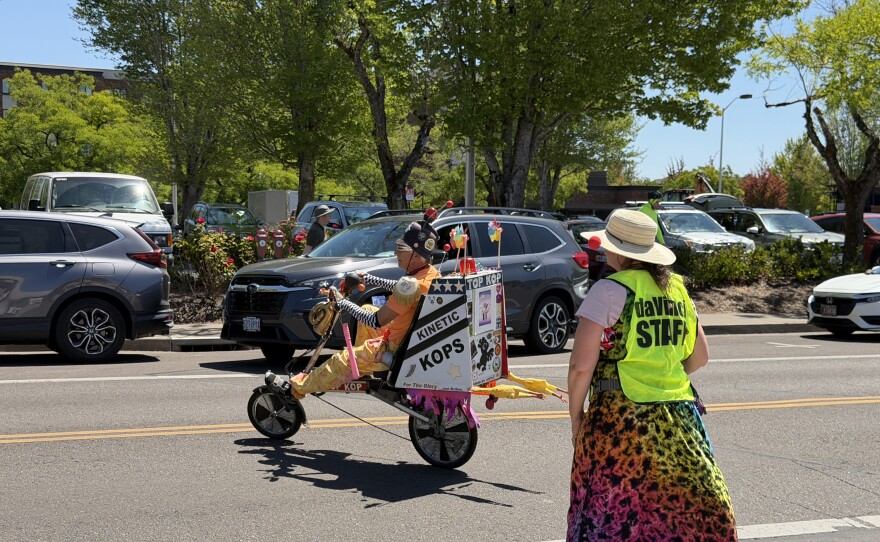
A quirky fleet of elaborately crafted, pedal-powered vehicles took over Corvallis on a recent Saturday for the 33rd Graand Kinetic Challenge kinetic sculpture race.
It has all the facets of a typical race. Teams anxiously wait at the starting line. A crowd gathers to cheer on their favorite participants.
But the race vehicles are a little less typical. Kinetic sculptures are generally art pieces that have some kind of movement — like the metal art pieces you might see moving with the wind in someone’s yard. In Corvallis, much larger sculptures are turned into custom-built, human-powered vehicles, typically pedaled like bicycles, built to withstand all kinds of terrain.
A large tiger towers over what looks to be four attached bicycles, with the race team donning orange and black to match. Another team’s vehicle looks like a hot dog, and another is a bright pink rabbit piloting a spaceship.
According to Race Director Stacey Newman Weldon, a kinetic sculpture race is something you have to see to believe. It’s two days of humans steering art vehicles over land and sand, through mud and water.
“So, if you think about it,” Newman Weldon said, “they're like Frankenstein bicycles with New Orleans-style floats on top.”
The Graand Kinetic Challenge — spelled that way as a tribute to the spelling of the race’s founder, Raan Young — began in Corvallis in 1993 as a part of a science and arts festival called Da Vinci Days.
Young attended a different kinetic sculpture race in Eureka, California, inspiring him to bring the race to Corvallis. Young was given a small budget from Da Vinci Days to host the first race. The race has been a part of Corvallis summers ever since.
The event begins with a pageantry portion, where teams show off the artistry of their vehicles. Teams then race through various terrain types, climbing up a sand dune at the Benton County Fairgrounds, wading through a mud bog at Crystal Lake Sports Park and finishing with a float down the Willamette River. This year's race did not have a floating portion, due to an emergency closure of the river.
The kinetic sculptures are judged on showmanship, speed and the ability to navigate through different terrain.
“The teams are basically made up of people who love this combination of engineering plus art,” Newman Weldon said.
The teams are varied in size, from a single person to a team of eight. Some team members are pilots who pedal and steer the kinetic sculpture. Others work as a pit crew to fix any technical issues and prepare the vehicles for the float portion.
Teams can win a variety of trophies and cash prizes for different aspects of the competition. The Graand Champion Award is given to the team with the best overall score.


Other awards are distributed for specific aspects of each vehicle, like the Cuddly Teddy Bear Award, judging which team has the most thematically appropriate stuffed animal mascot. That is Newman Weldon’s favorite award, and a specific Teddy Bear judge decides which team deserves it.
“She's been doing it for years,” Newman Weldon said of the judge. “She has her whole checklist of what she looks for.”
Sustainability also plays a role in the challenge, with many teams building their vehicles out of spare bicycle parts and other scrap materials. Newman Weldon said using resources to create the most innovative vehicle possible is at the core of this community.
“That's one of the fun things about kinetics is that it's really about failing up. And that's how you learn,” Newman Weldon said. “You fix things, you move on, and you try it again next year.”
Many of the racers have been taking part in the Graand Kinetic Challenge for years and participate in other races in the West Coast circuit.
Riki Bedford has been competing in the Corvallis race since 2005. Each year, Bedford’s race vehicle is banana themed, and this year was no exception, with her Banana’s In Bred sculpture.
Bedford pointed out the technical aspects and artistic touches of the two-person vehicle. A large banana sculpture sits on top and bread loaf sculptures adorn the sides.
“It's four-wheel drive, has two propellers. It has custom outriggers, custom cleats for sand and mud. It has a nice stereo,” she said. “People seem to really enjoy bananas and all the fun art that I've put on it over time.”
Bedford said she continues to participate in the race annual because of its community.
“We have a lot of camaraderie amongst teams. We all help each other out,” she said.
Bedford also pointed to a phrase that anyone attending or participating in a kinetic sculpture race will hear. The phrase goes back to the founder of kinetic sculpture racing, Hobart Brown, who started the first races in Ferndale, California, in 1968.
“And Hobart, at one point, I think someone asked him, ‘Why do you do it?’ And he said, ‘For the glory,’” said Bedford. “So, that's why we do it: for the glory.”
Newman Weldon said people keep coming to the Graand Kinetic Challenge partly for the competition, but mostly for fun.
“I mean, it's a lot of hard work to make those machines and obviously putting on an event this size,” said Newman Weldon. But, she added, the joy on everybody's faces and the “silliness that you can get away with” make it all worth it.
“The founder Hobart Brown, when he was starting the races, he wanted to show adults having fun so that kids would want to grow up,” she said. “Look at all the great things we get to do.”
The Graand Kinetic Challenge is every third weekend of July in Corvallis.

