Play Live Radio
Next Up:
0:00
0:00
0:00 0:00
Available On Air Stations

Grand Ronde tribal members publish book with animal and plant names in two regional Indigenous languages

Two men at table covered with books.
Photo provided by David G. Lewis.
Saghaley Lewis (left) and his father, David G. Lewis (right) at the Lane County Fair this summer, selling their books. This included "Kalapuya-Chinuk wawa Ikanum," that they worked on together.

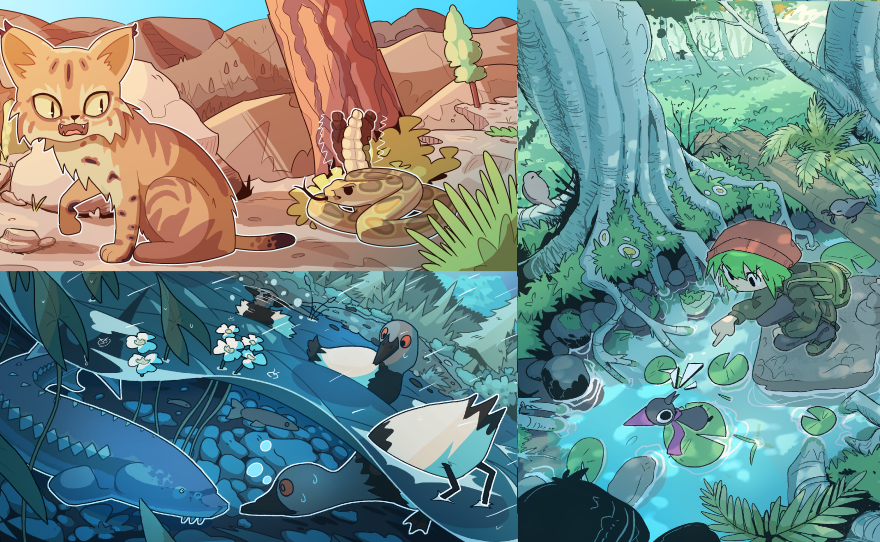
A bobcat glares at a rattlesnake in the high desert; a duck dives underwater and comes face-to-face with a sturgeon; wolf cubs circle a nervous elk in a cedar grove. These are but a few scenes readers can find in “Kalapuya Chinuk wawa Ikanum,” a 26-page self-published book that teaches the names of wildlife in the English, Kalapuya and Chinook languages.

Research and writing was done by David G. Lewis, an assistant professor of anthropology and Indigenous studies at Oregon State University. He’s written articles and a book about Indigenous people in the Willamette Valley, and maintains a blog about the region’s culture and history. Lewis said he was inspired to do the book after seeing a similar children’s board book produced by the Cow Creek Tribe, which shared animal names in the Takelma language.

Book cover with illustrated animals.
Photo by Brian Bull
/
KLCC
The front cover of "Kalapuya-Chinuk wawa Ikanum," illustrated by Saghaley Lewis.

“I got the actual spellings from the experts, and then I also wrote a little bit of history on the language programs themselves,” said Lewis. “And then I also wrote a little bit on the history of the language programs themselves, whether or not Kalapuyan is spoken anymore.”

“Kalapuya” and “Chinuk wawa” refer to the languages featured in the book, while “Ikanum” is a Chinuk wawa word meaning “oral histories” or “stories,” according to Lewis. The book includes a full listing of glossary terms at the back, which provides readers with the names of the featured plants and animals in all three languages. (For example, the name for deer is also “atálim” and “mawich.”)

Lewis’ 25-year-old son, Saghaley, did the illustrations. He’s done commissions and projects here and there, and maintains an Instagram page that features fan art and original works. Roughly two years ago after his father observed his growing talent and popularity, he asked Saghaley about collaborating on a book.

The immediate reply?

“Sure.”

Multiple inspirations for the rising artist

The younger Lewis said he’s largely self-taught, but studied visual communications and multimedia arts at Chemeketa Community College and video and game design at Salem’s Career Technical Education Center program. Many of his works are evocative of sci-fi and fantasy worlds including those shown in Studio Ghibli films, the existentialist movies of Fritz Lang, and the cyberpunk/dystopian future seen in “Bladerunner.” Lewis said he draws a lot of his inspiration from Spanish illustrator Carles Dalmau, as well as several animated series from Glitch Productions, including “Murder Drones,” “Knights of Guinevere,” and “The Amazing Digital Circus.”

“It's sort of a mix between Western cartooning and manga-ish anime,” he said.
Both Lewises are currently working the holiday market circuit across the region, where copies of “Kalapuya-Chinuk wawa Ikanum” are prominently displayed on a tabletop.

“Kids walk by and they're like, ‘Whoa, what's that?’ Like it just pops out at them, it makes me happy when kids enjoy it,” said Saghaley Lewis.

The self-published book can be found at several shops including the Springfield History Museum and the Spirit Mountain Casino, as well as ordered online from the Lewises’ personal sites. These can be individual copies or bulk orders sold at wholesale prices.

One enthusiastic supporter is Madeline McGraw, the Springfield museum’s curator. She said she’s long respected David G. Lewis, back when he advised an exhibit called Illumination that collected and shared oral histories from marginalized communities, including those of Alaska Native people in Springfield.

“Usually we try to find things that are related to this part of the Willamette Valley,” said McGraw. “And we were chatting and (Lewis) was like, ‘Oh, I’ve got a new book’ and I was like, ‘Alright, whatever it is, gimme gimme!”

McGraw said colonization through the centuries has inflicted many “horrible things” upon Indigenous people, including the eradication of the Kalapuya language.

“So there's not a lot of resources out there for people to learn more about it, especially for kids,” she said. “So to have something that includes Chinuk wawa and Kalapuya, and in a format where we can get it out to the public, that's just a slam dunk in my book.”

McGraw said the collaboration between David G. Lewis and his son just makes the book all the more special. “Saghaley’s artwork is just so striking and so amazing. It's an important book. It's a well-made book. And so we want to see them succeed. We want to see this book get out.”

Meanwhile, the younger Lewis is exploring a new book with his mother Donna, a special education teacher who works for the Salem-Keizer Public Schools. It’ll focus on special education students and feature his illustrations as well. Once that’s done, he and his father will explore further collaborations on children’s books that explore Indigenous languages.

Copyright 2026, KLCC News.

Brian Bull is a part-time reporter for the KLCC News department who first began working with the station in 2016. He's a senior reporter with Underscore Native News and was also a journalism professor at the University of Oregon.

In his 30 years working as a public media journalist, Bull has worked at NPR, Twin Cities Public Television, South Dakota Public Broadcasting, Wisconsin Public Radio, and ideastream in Cleveland. His reporting has netted dozens of accolades, including four national Edward R. Murrow Awards (25 regional), the Ohio Associated Press' Best Reporter Award, Best Radio Reporter from the Indigenous Journalists Association, and the PRNDI/NEFE Award for Excellence in Consumer Finance Reporting.
Related Content
  • The second annual Indigenous Comic Con was held in Albuquerque, N.M., this month. It brought together indigenous comic book creators, game designers, actors and even an astronaut.
  • Tarweed Awakening Corvallis is a multi-day community event that helps us learn about the values of the Tarweed (asawal) plant, a critical first food of the Ampinefu Kalapuya. In partnership with this event, we are hosting a Native Arts Marketplace!

    The Native Arts Marketplace will happen at the Corvallis Museum on Thursday, August 20, as a kick-off celebration for the weekend festival. Buy handmade art, jewelry, clothing and accessories and support local Native artists. Guest Artist Brenda Brainard will give an artist talk at 5:30 about her work as a traditional basket weaver.

    Additionally, interpretive hikes, lectures, and hands-on demonstrations about tarweed and first foods will be happening from Thursday, August 20 through Saturday, August 22, 2026! More details on the Tarweed Awakening Corvallis event page.

    Awakening co-sponsors include: OSU Indigenous Studies Program, Corvallis Sustainability Coalition, Tarweed Folk School, Wild Yeast Bakery, and Benton County Historical Society.
  • Louie Gong is a Native American visual artist and designer who got his start decorating Vans sneakers. Today he's one of the most successful Native entrepreneurs in the country.
  • This academic year Native American and Indigenous Studies, English, and Comics and Cartoon Studies will present the Indigenous Comics Speaker Series at the University of Oregon.

    The series begins with Michael Nicoll Yahgulanaas, an award-winning visual contemporary artist and author, on Wednesday, October 11, 2023 at 4 p.m. in the Knight Library Browsing Room. Yahgulanaas’s publications include national bestsellers Flight of the Hummingbird and RED, a Haida Manga. His most recent publication is JAJ: a Haida Manga (May 2023).

    Yahgulanaas became a full-time artist after many decades working as part of the Haida Nation’s successful campaign to protect its biocultural diversity. He is a descendant of iconic artists Isabella Edenshaw, Charles Edenshaw, and Delores Churchill, and he had early training from exceptional creators and master carvers. In the late 1990s, after exposure to Chinese brush techniques, he consciously began to merge Haida and Asian artistic influences into his self-taught practice, and created the art form called “Haida Manga.”Cover of the book JAJ showing the art

    Haida Manga blends North Pacific Indigenous iconographies and framelines with the graphic dynamism of Asian manga. It is committed to hybridity as a positive force that opens a third space for critical engagement. That hybridity becomes woven through the artist’s art, books, and speeches, and offers an empowering and playful way to view and engage with social issues.

    Exploring themes of identity, environmentalism, and the human condition, he communicates a worldview that is, while particular to his ancestral North Pacific archipelago of Haida Gwaii, also relevant to a contemporary and internationally-engaged audience.

    In addition to his public talk, Yahgulanaas will visit two classes and engage with the Native American and Indigenous Studies Academic Residential Community at the Many Nations Longhouse.

    The series will continue in winter term with Cole Pauls, a Tahltan comics artist, illustrator, and printmaker from Haines Junction, Yukon Territory; and in spring term with artist Arigon Starr, an enrolled member of the Kickapoo Tribe of Oklahoma and one of the founders of the Indigenous Narratives Collective (INC), a group of Native American comic book writers and artists.

    The Indigenous Comics Speaker Series is free and open to the public.