


The Wasco County blaze is one in a series of fires that have burned large swaths of Oregon, straining local resources and piling on the emotional toll on residents.
When Lisa Sethmann checked out of the Fairfield Inn in The Dalles, it was her third hotel room in four days. Evacuees and fire personnel had packed all the local hotels during the previous week, as the Grasshopper Fire raged across Wasco County. Finding an available room proved challenging.
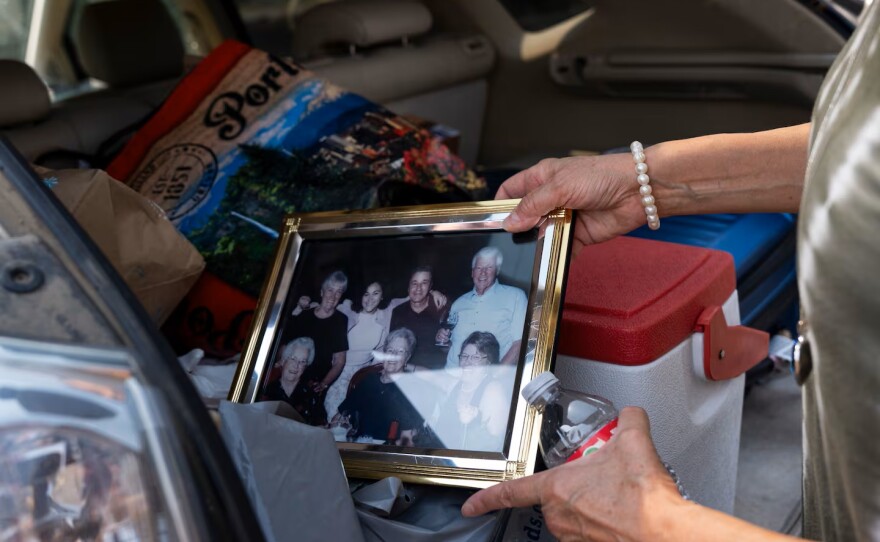
She stored photos of precious memories from her life in the trunk of her car: a honeymoon in Greece, her parents’ first wedding anniversary and a European vacation with her sister. She prepared to drive home, not knowing what would be left or if she’d have to leave again.
“It’s very stressful because you’re wondering what you’re going to see when you go there the next day,” Sethmann said. “You’re wondering if your house is there.”
The Grasshopper Fire, just east of Mount Hood, has burned nearly 90,000 acres as of Sunday and destroyed multiple buildings.
It’s just one in a series of large, destructive fires in what has been a record-breaking wildfire season for Oregon. Many of these blazes, though miles apart, bear some resemblances: Small communities fear the destruction of their homes and livelihoods, while exhausted fire crews try to maintain control in extremely difficult conditions.
Firefighters and residents in Wasco County described harrowing efforts to save properties and help out their neighbors. But even for an area that’s no stranger to wildfires, there’s an acknowledgement that this season is something unique.
‘One of the scariest things’
As Sethmann drove to her home in the tiny community of Friend, evidence of the fire filled in the landscape. Golden wheat fields morphed into blackened terrain. Helicopters moved between pillars of smoke, before scooping water from a nearby pond. Fire crews crowded around Friend’s historic one-room schoolhouse, the only landmark for miles.
When she and her husband, John, pulled up to the home, the fire had come within a few feet of their home. Luckily, John Sethmann had spent the past few years maintaining a patch of fresh, green grass around his property, which doesn’t spark as easily, and likely saved their home.
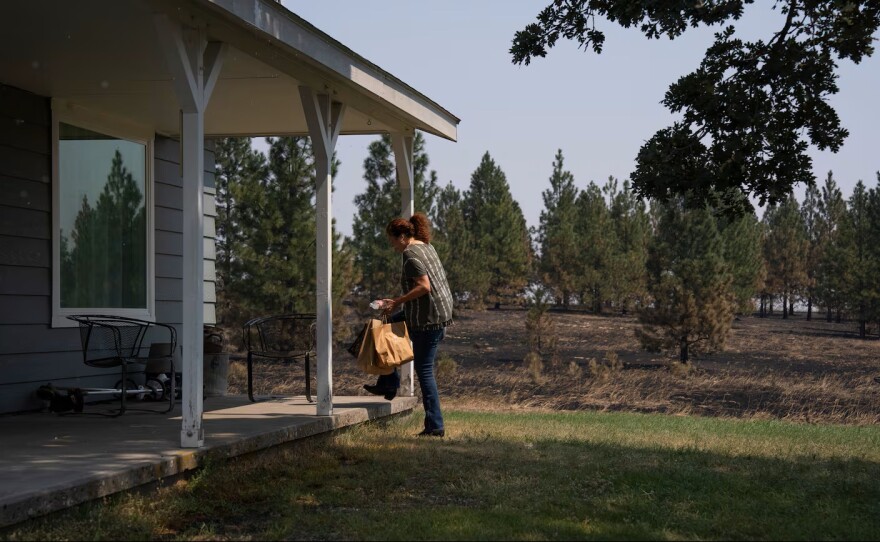
John and his father built this house from scratch in 1978. From the porch, he and Lisa could still see new plumes of smoke dotting the horizon. The roar of the helicopters never ceased. There’s the knowledge that, even though their home stands, things won’t quite be the same.
“There is a certain peacefulness and serenity out here that you just can’t get in a more populated area,” Lisa Sethmann said. “I’m going to look out the windows and I’m going to see burn, and I’m going to not see my deer for a while. It’s changed.”
The Grasshopper Fire has been burning in this region since late July. A lightning strike just east of Mount Hood sparked the initial fire, and extreme winds carried the blaze deep into Wasco County, closer to people’s homes.
The worst of it came on Monday, Aug. 10. High winds caused the fire to race quickly through Friend, sending residents and fire crews scrambling. Wasco County Sheriff Lane Magill later said an additional 12,000 acres burned in one hour during the surge. Even in such a sparsely populated area, many homes laid in its wake.
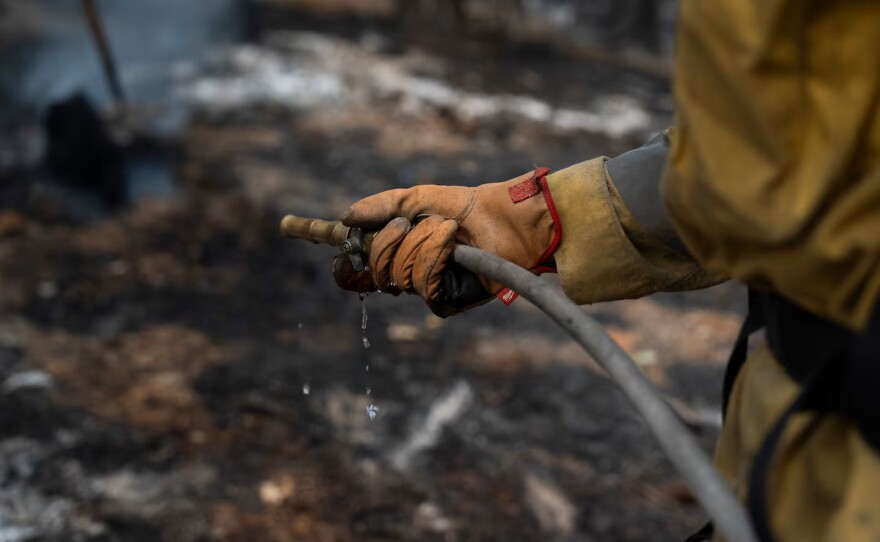
Greg Barnum, a veteran firefighter working with the Oregon State Fire Marshal’s Office, stayed with a small team that night to save what structures they could. They set up hose lines around homes and watched as the fire quickly circled around them on all sides.

“It’s one of the scariest things you can be in,” Barnum said. “It’s a wall of fire rushing at you. Depending on the fuel content, it sounds like a freight train was coming through the trees. It is so noisy.”
Other homeowners defied evacuation orders and stayed through the night to protect their property.
One of them was Cody Masterson. It had taken him four years to build his house in Friend. Just hours after signing the final papers for the property, the Grasshopper Fire started racing toward his new home. He chose to stay and fight the blaze. He said he stayed up until 3 a.m. putting out hot spots that started near the house in extremely dangerous conditions.
“It’s just an inferno,” Masterson said. “Flames are coming up over the top of the bank, like towards the house, and embers are burning you in your hair, in your eyes.”

Somehow, he managed to save his home from destruction. Others were not so fortunate. In total, the fire destroyed six homes and many more structures as of Sunday. Many of them were Masterson’s neighbors.
“All the houses straight west of me are all gone, except two,” he said. “It looks literally like the moon up there. There is nothing left.”
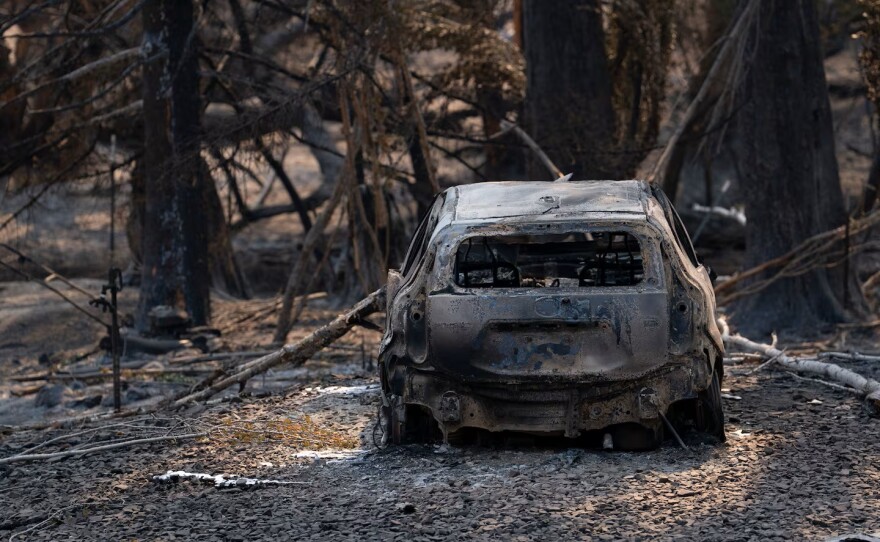
Days later, much of the wreckage was still visible. Entire homes were reduced to rubble, metal roofs wadded up like tissue paper. At one home located at the base of a small valley, a scorched washer and dryer were the only recognizable artifacts in the of scrap metal.
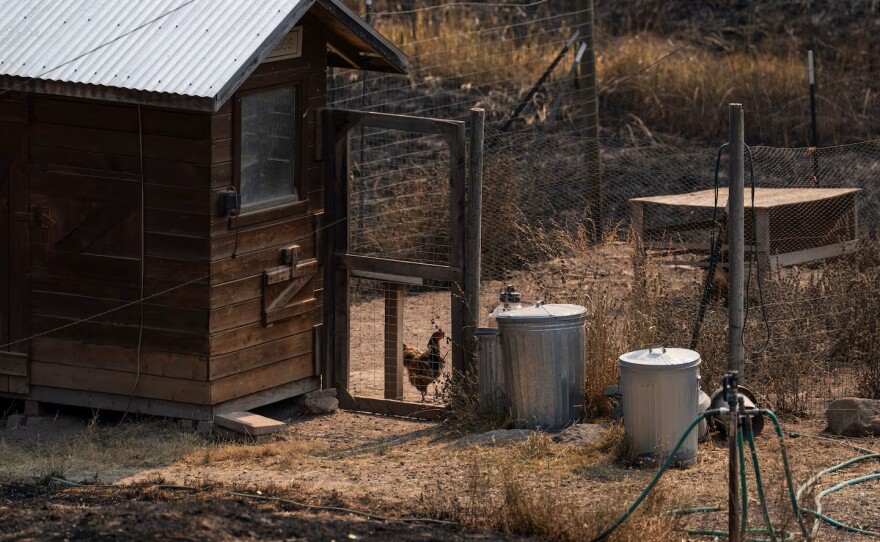
Strangely, a garden and chicken coop near the home remained perfectly intact. Several chickens clucked and sauntered next to piles of ash — unlikely survivors of the fire and the only living remnants of the life that once existed at the home.

Making do with less
Days after the destruction, the work to protect homes in Wasco County continued.
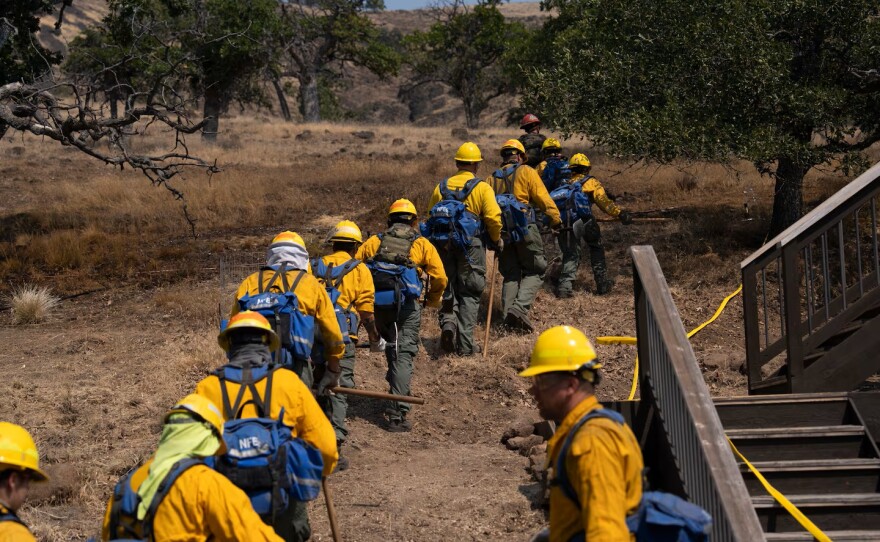
A couple dozen members of the Oregon Air National Guard met outside Tom Liethen’s home, with the fire line only about a mile away. Crews moved flammable objects away from the home, placing porch furniture inside and piles of pine needles away. They created a defensible line around the house by digging up grass and other potential fuel.
Located on a steep hill, the home overlooks a beautiful canyon and a sea of trees. Liethen, 84, has owned the property since the early 1990s and remembers when big fires occurred about every decade. Now, it feels like every other year.
“You can’t realize how grateful I am,” Liethen said of the help.
Of course, all the preparation in the world is no guarantee. Chris Baker, planning section chief for Oregon State Fire Marshal, said winds in the area can reach up to 60 miles per hour at times. As the Grasshopper Fire has shown, winds can also change direction at a moment’s notice.
“I feel confident in our work,” Baker said. “I’m not confident in the weather conditions. The weather conditions can be very unpredictable, and that’s the problem.”
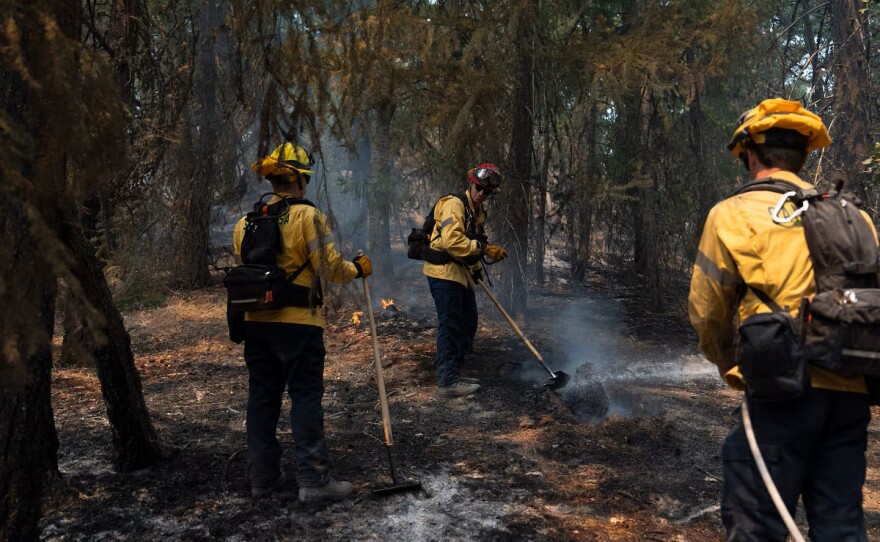
Complicating matters further has been the strain on firefighting resources nationwide. It’s been an incredibly active wildfire season across the country and the world. Jon Wallace with the Southern Area Incident Management Team said trying to acquire enough resources — from manpower to bulldozers — is challenging.
“There’s just so many fires going on, and it seems like every fire that’s going on has structures threatened,” Wallace said. “Every fire that’s going on has critical power lines, critical roads that are threatened, and so the resources are just getting stretched thinner and thinner.”
One recent example has been hotshot crews, which are made up of some of the most experienced wildland firefighters and are critical in tough terrain. Wallace said his five hotshot crews will soon have to take a mandatory break, and there are no crews available nationally to take their place.
So, leadership has had to get creative. The hotshot crews had been vital for the southwestern corner of the fire, which contains steep slopes and hard-to-reach areas. In their absence, the plan is to lower huge logging machines down 60-degree slopes with winch cables, disrupting the fuel bed and creating a fire line.
It’s an unorthodox method, but Wallace said options are limited.
“Three days ago, we would have probably tried to put a hotshot crew,” he said. “We can’t get any hotshot crews, so we’re getting creative and finding another solution.”
And those efforts appear to be moving in a positive direction. Containment jumped to 38% as of Sunday, while evacuation areas have decreased.
Wallace said the goal this season is to make strides on the fire as fast as possible — not just to save homes, but so firefighters can deploy to newer fires across the country.
“We’re going at this and pushing folks as hard as we can, because we know there’s going to be another fire to go to after this one,” he said.
Saskia Hatvany contributed reporting to this story.

This story comes to you from the Northwest News Network, a collaboration between public media organizations in Oregon and Washington.

