


When you’re driving down 9th Street in Corvallis, you might not be aware of what's lying underneath. Just off of Linden Avenue–within a stone’s throw of a present-day Starbucks and Cold Stone Creamery–something historic was discovered in 2021. A utility crew that was supposed to be digging up a natural gas pipeline found a 12,700 year old Columbian Mammoth tusk instead.
Jeff McConnell remembers getting the call. He’s a Corvallis Public Works City Engineer, and said it’s common practice to take a closer look at any strange findings. While the NW Natural crew was digging with an excavator, the bucket started bringing up an unusual material.
“There's teeth on the bucket that help to dig. One of the teeth scraped the side, and the other one broke through the tusk. It brought up this chalky material,” said McConnell. “They knew they hit something.”
McConnell contacted Oregon State University Anthropology Professor Loren Davis, who had past experience preserving artifacts in the Willamette Valley.
“I asked him how hard would it be for Public Works to remove this, excavate it, and try to preserve it,” said McConnell.
It would take time, but Davis was willing to help. They agreed to excavate the tusk the following summer, and Davis would use it as a project for his anthropology graduate students.
“We buried the tusk in sand and put plywood over the top of it, and then planned for the next summer to come back, and give Loren some time to have his students come out and excavate the tusk,” said McConnell.
Davis said he and the students spent three days in the hole, cleaning up the tusk and determining the best method of removal.
“Then I put plaster-soaked burlap around the tusk to give it some support, basically we were creating a cast, like if you had a broken arm, you'd put a cast on it, and we wanted to support it,” said Davis.
Once you remove the weight of the dirt and sediment, the tusk can start to crack. Casting prevented this and allowed the preservation crew to lift it out of the ground.

Davis noticed the rest of the tusk seemed to extend into parts of the street that were not dug up during the gas pipeline project. What does that mean?
“If there is more of the animal, then it is still under the street in Corvallis,” said Davis.
Davis said the Willamette Valley is a particularly good spot to find remains like this, because the sediments in the valley are the same age as when mammoths were alive.
“So you can't just go anywhere on the Earth's surface and dig a hole and expect to find something like that,” said Davis. “You have to kind of go to places where the dirt of the right age exists.”
Once excavated, the tusk was left in the plaster encasing to slowly dry out for two years, which prevents peeling and cracking. Davis and a group of graduate students then coated the tusk in a preserving agent and built a plaster support around it.
With the tusk ready for display, Public Works contacted the Corvallis-Benton County Public Library.
Library Director Ashlee Chavez said she jumped at the opportunity to showcase a unique piece of Corvallis history.
“The big idea was for it to be in a place that was accessible by all people,” said Chavez. “Where people could just come in and experience the excitement of seeing the tusk that had been under 9th Street.”
A custom wooden case was built by the Highland Woodshop in Corvallis to display the tusk. The shop donated all the labor costs, and the library’s Friends & Foundation raised funds to buy the materials.
The case was built at a lower height so kids can see the tusk at their level.
“And we tried to put it close to the entrance. So even if you weren't expecting it, you might stumble across it and be surprised,” said Chavez. “Or if you come here looking for it, you don't have to go too far to find it.”


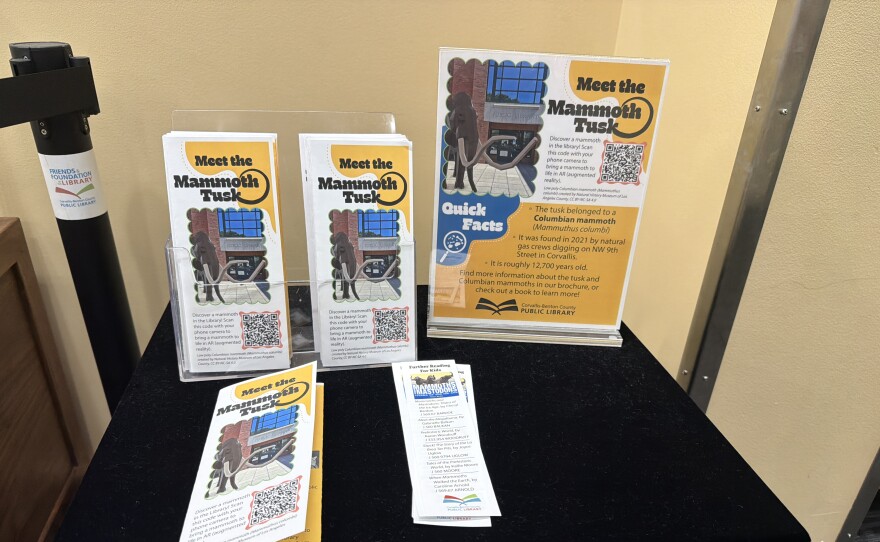
Chavez said seeing the reactions to the new tusk exhibit has been the best part.
“People are just really taking joy in being able to see this cool piece of our history,” said Chavez.
McConnell said he thinks the tusk ended up in the perfect spot for anyone in the community to see and learn about.
“We could put it at City Hall or in Public Works, but it doesn't get the traffic that the library does,” said McConnell. “I think it's a good spot.”
The mammoth tusk is now on display at the Corvallis-Benton County Public Library. You can find it just off the lobby, next to the children's section.


